
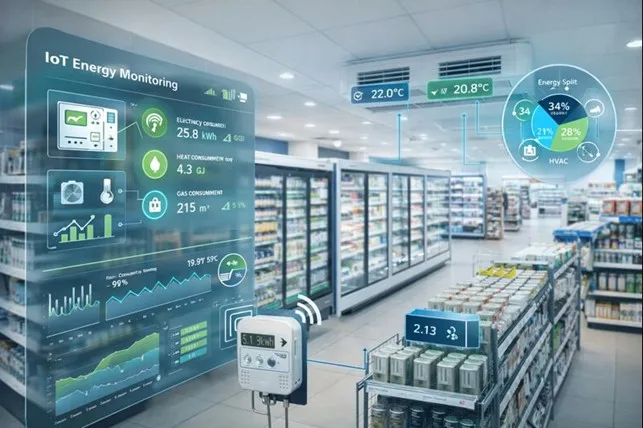
Retail chains operate hundreds or even thousands of locations, each consuming electricity, heating, cooling, and refrigeration energy every day. Even small inefficiencies multiplied across a network lead to significant financial losses. This is where IoT-driven energy management becomes a strategic advantage.
The Energy Challenge in Retail
Retail stores face several common challenges:
- Lack of real-time visibility into energy consumption
- High energy costs for refrigeration and HVAC
- Delayed detection of abnormal consumption or failures
- Manual reporting and limited analytics
Traditional monthly utility bills do not provide actionable insights. IoT changes this approach completely.
IoT-Based Energy Monitoring
By deploying IoT sensors and meters connected via LoRaWAN, retailers gain continuous visibility into:
- electricity, heat, and gas consumption,
- refrigeration system performance,
- HVAC operation and anomalies,
- store-level and network-wide energy trends.
Data is transmitted automatically from basements, technical rooms, and hard-to-reach areas without complex cabling or expensive connectivity.
Business Value for Retailers
IoT-based energy management enables:
- early detection of abnormal consumption,
- reduction of energy losses and peak loads,
- comparison of stores by efficiency benchmarks,
- data-driven decisions for modernization and investments.
Retailers typically achieve 5–15% energy cost savings within the first year of deployment.
Scalability and Integration
IoT solutions are scalable by design. Retailers can start with pilot stores and expand to the entire network, integrating data into BI systems, ERP, or energy management platforms.
Conclusion
Energy monitoring is no longer just a cost-control tool — it is a foundation for sustainable and competitive retail operations. IoT enables transparency, efficiency, and measurable financial impact across retail chains.