Introduction
Kremenchuk Teploenergo, together with our partner Aquatechmontazh LLC, set the goal to migrate heat meter monitoring in one of Kremenchuk’s residential districts to an online mode and ensure stable telemetry collection even in challenging basement environments.
Background
In district heating companies, a significant portion of data from heat metering points is still collected manually: on-site visits, manual readings, and operational checks. This approach:
- consumes a lot of staff time,
- makes real-time incident monitoring difficult,
- increases the risk of missed readings or human errors,
- prevents fast detection and analysis of anomalies and heat losses.
We delivered a full-cycle, turnkey IoT project:
LoRaWAN Network Deployment
- site surveys and analysis of typical meter installation locations (basements, chambers),
- coverage planning and gateway placement,
- installation and initial configuration of the LoRaWAN network infrastructure.
Heat Meter Connection via M-Bus
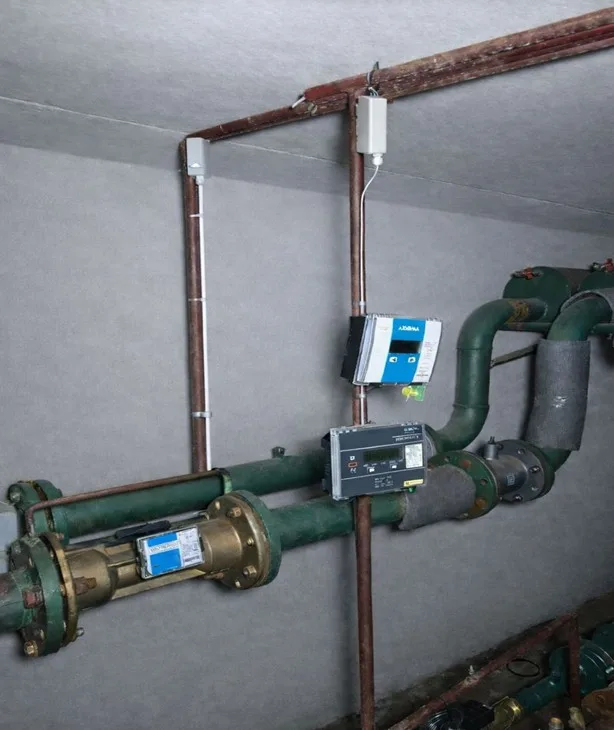
At the sites, M-Bus modems/gateways were installed to read data from heat meters and transmit it via LoRaWAN to the data collection platform.
This enables:
- continuous acquisition of consumption data,
- monitoring device and communication availability,
- detection of abnormal conditions (power loss, communication failures, read errors).
Telemetry Configuration and Integration Readiness
- definition of data transmission intervals,
- unification of data structures for analytics,
- preparation of integration interfaces for dispatching systems, BI platforms, or SCADA (if required).
Implementation Challenges
Heat metering points are often located in harsh conditions: high humidity, metal structures, low ceilings, and limited access. During implementation, together with our partner, we focused on:
- clean and reliable installation with proper protection of connections,
- stable power supply and well-organized cable routing,
- on-site radio link quality verification, not only coverage map analysis.
Conclusion
After deployment, Kremenchuk Teploenergo achieved:
- real-time visibility of heat and hot water delivery volumes, supporting financial and revenue analysis,
- fully remote monitoring of heat meters,
- immediate understanding of which metering points are online and which require attention,
- reduced manual labor and minimized human-factor risks,
- a scalable foundation for future development: integration of additional sensors (temperature, pressure, flooding, cabinet opening), network expansion, and advanced analytics and reporting.