
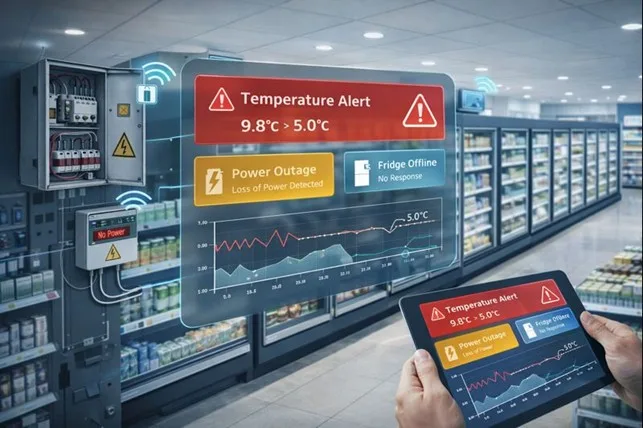
In retail, downtime and unnoticed failures directly translate into lost revenue. Refrigeration breakdowns, temperature deviations, or power outages can cause product spoilage and regulatory risks. IoT helps retailers move from reactive to proactive operations.
Operational Risks in Retail Stores
Common operational issues include:
- refrigeration failures outside working hours,
- temperature violations for food and pharmaceuticals,
- power outages and unnoticed equipment downtime,
- lack of centralized visibility across stores.
Manual checks are unreliable and cannot provide 24/7 coverage.
IoT for Real-Time Operational Control
IoT sensors continuously monitor:
- temperature in refrigeration units and cold rooms,
- power availability and outages,
- door openings and unauthorized access,
- environmental conditions in technical zones.
Using LoRaWAN, sensors work reliably even in metal-filled technical rooms and basements.
Alerts and Incident Prevention
IoT platforms generate automatic alerts when:
- temperature exceeds allowed thresholds,
- refrigeration equipment stops responding,
- power supply is interrupted,
- abnormal behavior is detected.
This allows maintenance teams to respond before losses occur, not after.
Benefits for Retail Chains
With IoT-based operational monitoring, retailers gain:
- reduced product spoilage and write-offs,
- faster incident response times,
- improved compliance with food safety regulations,
- centralized control of distributed store networks.
Future-Proof Retail Infrastructure
IoT infrastructure can be extended with:
- energy monitoring,
- predictive maintenance analytics,
- integration with dispatch systems,
- AI-based anomaly detection.
Conclusion
Smart retail operations require continuous visibility and fast response. IoT provides retailers with the tools to protect revenue, improve reliability, and scale operations efficiently.